
Finding Stronger Fall Photography Compositions Along Washington’s Highway 2
Fall can be an incredibly rewarding time for landscape photography. With so much color and so many beautiful scenes competing for our attention, the photographic opportunities can feel endless. But that abundance also creates a challenge. When everything looks interesting, how do you decide where to stop, what to photograph, and how to create a composition that really works?
That’s exactly what I set out to explore during a fall photography trip along Highway 2 in Washington. This scenic stretch of the Pacific Northwest offers countless opportunities to photograph autumn foliage, from golden stands of aspens to colorful hillsides, rivers, and mountain scenery. But rather than simply chasing the brightest fall colors, I wanted to focus on something that can make a much bigger difference in the quality of our landscape photographs: learning to recognize the elements that matter most and building compositions around them.
Throughout this trip, I encountered everything from dense forests filled with competing colors and patterns to misty hillsides and expansive mountain landscapes. Each scene presented a different compositional challenge, and each required me to think carefully about what I wanted the photograph to communicate. Sometimes that meant using a telephoto lens to isolate a small section of the landscape. Other times, it meant stepping back, changing my position, or choosing a completely different perspective.
Photographing Fall Colors in the Rain
My first day photographing along Highway 2 was a very typical Pacific Northwest fall day. It was raining, and quite a bit more heavily than I had expected. While getting my equipment wet and spending the day feeling cold and damp wasn’t particularly appealing, the weather did offer a couple of advantages. For one, there weren’t nearly as many people out exploring the area, which made it easier to stop and photograph without dealing with crowds.
The other advantage was the light. On bright, sunny days, photographing fall foliage can be challenging because of the harsh contrast between brightly illuminated leaves and darker areas of the forest. On this day, the thick clouds overhead acted like a giant softbox, producing beautifully diffused light. That softer illumination helped bring out the colors and textures of the foliage without the distracting highlights and deep shadows that can make forest photography so difficult.
As I drove along Highway 2, I kept looking out the window for areas with especially beautiful color and the potential for interesting compositions. There were opportunities everywhere, but I wasn’t just looking for colorful trees. I was paying attention to patterns, contrasting colors, and arrangements of foliage that might work together to create a compelling image.
One of the things that particularly catches my eye in the fall is a stand of aspen trees. Their white trunks create beautiful, repeating vertical patterns, especially when surrounded by brilliant golden leaves. Those combinations of line, color, and contrast offer wonderful opportunities for more intimate landscape compositions, provided you can find a viewpoint that minimizes the distractions.
Finding the Right Viewpoint Among the Aspens
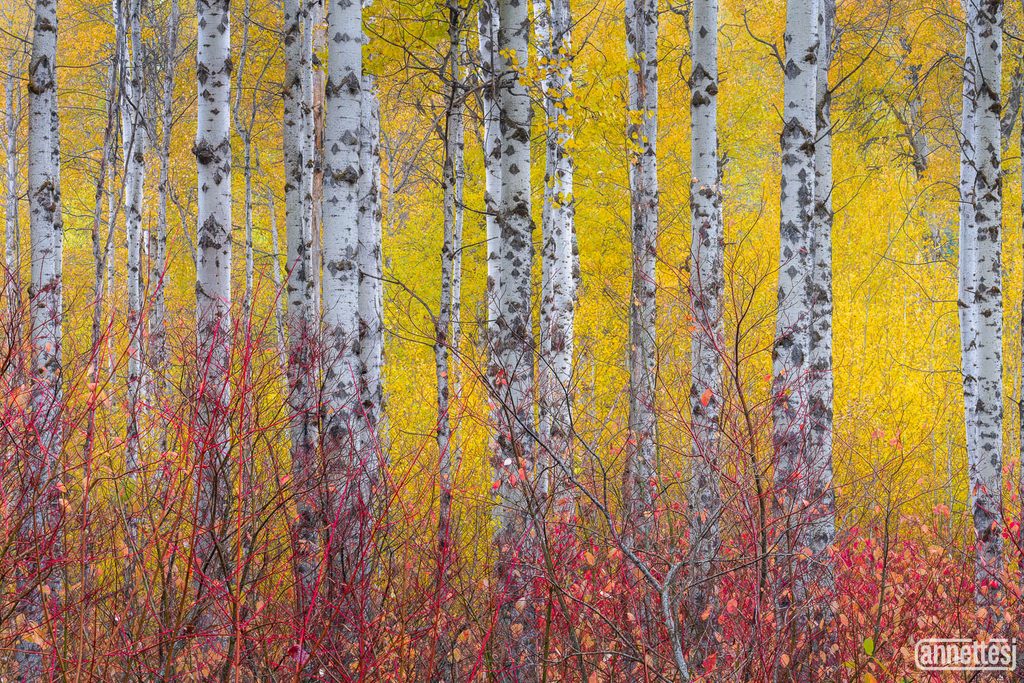
At my first stop, I found a particularly beautiful stand of aspens with tall white trunks, golden foliage, and some lovely red twigs growing in the understory. The red vegetation immediately caught my attention because it offered an opportunity to add another layer of color and texture to the composition without competing with the trees themselves.
Interestingly, the viewpoint I liked best wasn’t directly along Highway 2. I had turned off the highway and followed a road around to the other side of the trees, just five minutes or so from where I’d originally spotted them. From this direction, I felt I had an even better view, with a more consistent pattern of vertical trunks and fewer distracting elements in the frame. It was a good reminder that even a small change in position can make a significant difference in the strength of a composition.
As I evaluated the scene, I experimented with panning the camera in different directions to see how the arrangement of the trees and surrounding foliage changed. When I moved the frame toward one side, more random twigs and clutter began to interrupt the beautiful repeating pattern of the aspens. When I panned farther in the opposite direction, I started including patches of bright white sky and additional yellow foliage in the foreground. Those elements weakened the composition because they competed with the trees and reduced the separation between the foreground and background.
The viewpoint I ultimately preferred gave me a relatively clean arrangement of white trunks against golden leaves, with the red twigs framing the bottom of the image. The red foliage provided a contrasting foreground layer that helped create a sense of depth, while also adding color and textural interest. Most importantly, it supported the primary subject rather than distracting from it.
Once I found the composition I liked, I planned to experiment with both horizontal and vertical orientations, along with tighter framing. I wanted to see which arrangement best emphasized the patterns and contrast that had attracted me to the scene in the first place.
When I reviewed the resulting photograph from that beautiful stand of aspens, I felt that the composition really captured what had attracted me to the scene in the first place. The repeating white trunks, golden foliage, and contrasting red vegetation worked together to create an image that was much more cohesive than the broader scene I’d originally encountered.
One of the most important lessons I can share from this composition is just how effective a telephoto lens can be when photographing busy forest scenes. When we see a beautiful stand of trees, our first instinct might be to capture the entire scene. After all, there’s so much wonderful color and detail that we want to include! But the problem is that a wider composition often introduces all sorts of distractions, from random branches and inconsistent patches of foliage to bright white skies that pull attention away from the subject.
Using a telephoto lens allows me to zoom in on a much smaller portion of the landscape and isolate the elements that are most interesting. Instead of trying to include everything, I can concentrate on the combinations of color, pattern, contrast, and texture that make the scene special. In this case, the vertical lines of the white aspen trunks against the golden leaves provided a strong visual pattern, while the red foliage along the bottom helped frame the composition and give it depth.
Of course, simply zooming in doesn’t automatically make a photograph better. The smaller portion of the scene still needs to have something compelling about it. I look for strong repeating patterns, interesting textures, beautiful colors, and contrasts that help the main subject stand out. Once I’ve identified those elements, I can work on arranging them in the frame so that they complement one another rather than compete for attention.
I like to think of this process as finding the signal amidst all the noise. There’s so much visual information in a forest, but not all of it contributes equally to a photograph. By identifying the strongest elements and removing distractions, we can create a simpler composition that often has much more impact.
Finding Repeating Patterns in Another Stand of Aspens
As I continued exploring, I came across another stand of aspens that presented a similar compositional challenge. Once again, there was beautiful fall color and a wonderful pattern created by the vertical tree trunks, but the surrounding scene contained quite a few distractions. There was a road, patches of bright sky, areas of green foliage, and inconsistencies in the arrangement of the trees. All of those elements made it difficult to create a cohesive photograph of the broader landscape.
Rather than trying to make all those competing elements work together, I reached for my telephoto lens again. I wanted to isolate the most compelling part of the stand of trees, where the repeating trunks and golden leaves created a more consistent visual pattern.
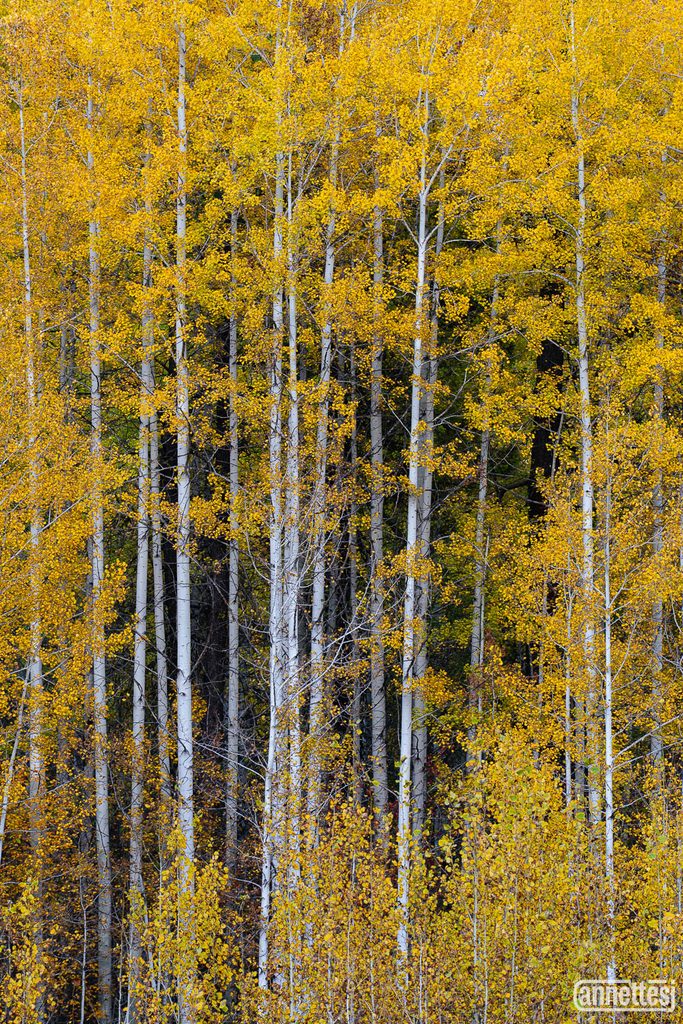
The resulting photograph is another great example of the benefits of using a telephoto lens for intimate forest photography. By excluding the road, sky, and surrounding clutter, I was able to concentrate on the two things that really mattered to me: the beautiful yellow foliage and the repeating pattern of the aspen trunks.
What I particularly like about this composition is the way the golden leaves frame the image along all its edges. In the center, the tree trunks create a relatively uniform pattern that gives the photograph structure and a sense of rhythm. The foliage around the edges helps contain the viewer’s attention within the frame, rather than allowing the eye to wander toward something distracting outside the main subject.
Both of these aspen photographs illustrate a principle I return to frequently in landscape photography: a successful composition is often as much about what you leave out as what you include. Finding a strong subject is only the beginning. The next step is deciding which surrounding elements actually contribute to the photograph, and which ones are better left outside the frame.
Creating Depth with Layers, Contrast, and Atmospheric Conditions
As I continued my journey along Highway 2, I eventually found another location that looked promising enough to stop. I was being fairly selective about where I photographed because the rain was making everything a little more challenging. Every stop meant getting my equipment out again, exposing it to the rain, and inevitably getting cold and damp myself. So I wanted to make sure there was something particularly interesting about a scene before going through all that trouble.
Once again, I turned off Highway 2 and followed a back road for a short distance. What caught my attention at this location was the combination of nearly bare aspen trees, dark green evergreens, and low clouds hanging between the surrounding ridgelines. Many of the aspens had already lost most of their golden foliage, leaving behind these beautiful white trunks with just a few yellow leaves clinging to the upper branches. Although the peak color had passed for those particular trees, I thought their exposed structure offered an entirely different photographic opportunity.
The repeating white trunks created a remarkably consistent pattern, and the lack of foliage made their vertical lines even more prominent. Behind them, the darker evergreens offered a strong contrast in both color and texture. Farther in the distance, clouds were drifting through the landscape, adding another layer of separation and atmosphere. There was also some reddish foliage in the ground cover, bringing a little additional color to the scene.
What interested me most was how all these elements could work together to create a photograph with distinct layers. In the foreground, I had the pale aspen trunks with their remaining yellow leaves. Behind those trees was a band of dark green evergreens, and beyond that, the soft white clouds rising between the ridgelines. Each layer was visually different from the next, which helped create a sense of depth even though I was photographing a relatively small section of the landscape.
I began experimenting with the framing to see how much of each layer I wanted to include. When I zoomed out a little, I could capture more of the clouds toward the top of the composition, which I liked because they added interest and atmosphere. Unfortunately, widening the frame also introduced a few distracting elements along the edges. There were some irregularities in the pattern of the trees that interrupted the consistency I was trying to achieve.
Rather than immediately rejecting the wider composition, I considered whether a different crop might solve the problem. I was initially working with a 2:3 aspect ratio, but I thought a 4:5 crop might allow me to eliminate some of those distractions while retaining the most interesting parts of the scene. This is something worth considering when you’re working in the field. Although I generally try to get the composition as close as possible in the camera, sometimes a slightly different aspect ratio can help refine the final image.
I also made sure to experiment with vertical compositions. When photographing a subject with so many strong vertical lines, a portrait orientation can be particularly effective because it emphasizes the height and direction of the trees. It’s easy to become accustomed to photographing landscapes horizontally, but the subject itself should help determine which orientation works best. Even if I ultimately prefer a horizontal photograph, trying a vertical version gives me another opportunity to evaluate how the elements relate to one another within the frame.
One practical consideration when exploring these smaller roads along Highway 2 is that many of the surrounding areas are private property. I made sure to stay along the roadside while photographing rather than wandering into the nearby forest or fields. There are plenty of beautiful compositions that can be found from accessible roadside viewpoints without needing to venture onto private land.
Finding Beauty in the Nearly Bare Aspens
My favorite photograph from this location ended up being another relatively tight telephoto composition. Rather than including the entire hillside, I zoomed in on a small section where the repeating white trunks, darker evergreens, and clouds worked particularly well together.
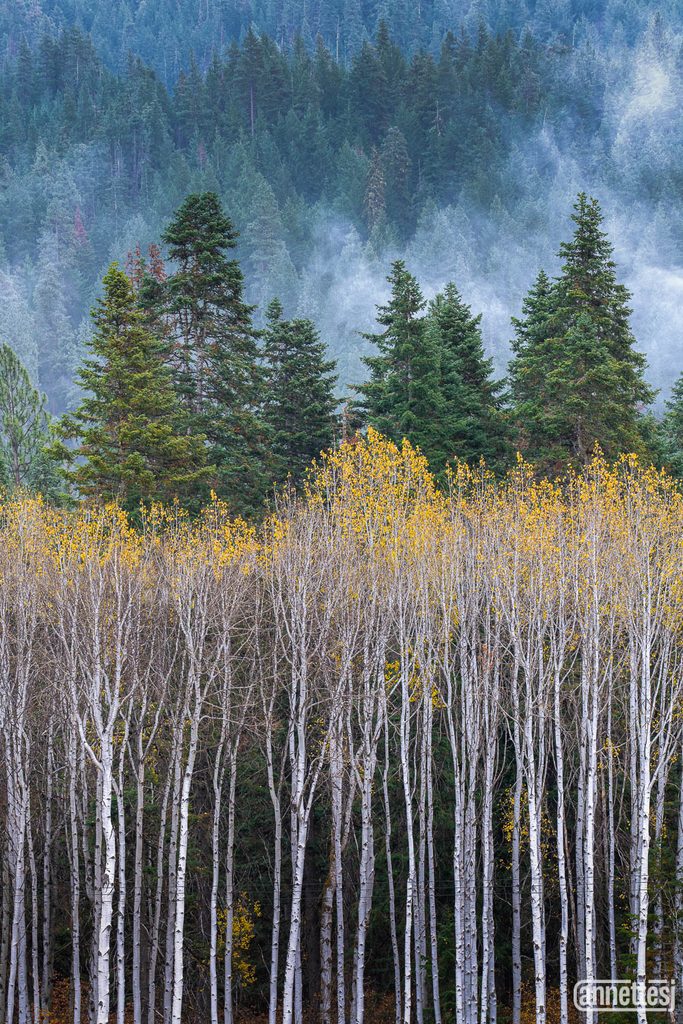
I love the almost abstract quality of this image. The aspens in the foreground are nearly bare, their pale trunks looking almost ghostly against the darker forest behind them. There are just enough yellow leaves remaining to remind us that we’re photographing the tail end of the fall season, but the emphasis has shifted from colorful foliage to the beautiful structure of the trees themselves.
The evergreens in the middle ground provide a strong contrast to the white bark, while the clouds rising in the background add mood and atmosphere. The separation between these three layers helps give the image depth, and the contrast between them makes each one easier to distinguish.
In a wider composition, many of these interesting details would have become lost within the broader landscape. The white trunks would have appeared smaller, their repeating pattern would have been less prominent, and the relationship between the trees, evergreens, and clouds wouldn’t have been nearly as strong.
This is another reason I find telephoto lenses so useful for landscape photography. They allow me to concentrate on relationships between individual elements of a scene, rather than automatically including everything in front of me. In this photograph, the patterns, contrasting colors, and atmospheric conditions were what made the composition interesting. By focusing on those elements, I was able to create an image that felt much more intentional.
Using Roads as Leading Lines in Fall Photography
While photographing at this same location, I noticed another potential composition looking down the road toward some beautiful fall foliage. This was a completely different kind of scene from the layered aspen photograph, but it offered another opportunity to use composition to direct the viewer’s attention.
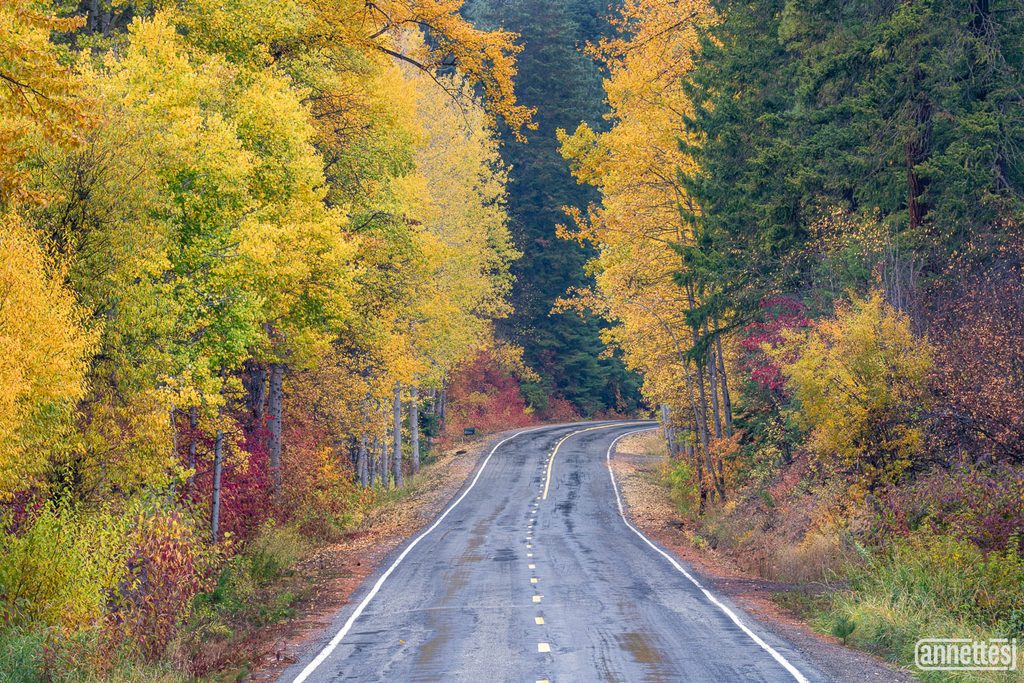
Roads can make excellent leading lines in landscape photography because they naturally guide the viewer’s eye through the frame. In this case, the road led directly toward the colorful autumn trees in the distance. I liked how the composition created the feeling that you could walk right into the scene, following the road toward the beautiful foliage.
I experimented with both horizontal and vertical orientations to see which worked best. Initially, a vertical composition seemed like it might be appropriate because the road itself created such a strong line into the distance. But when I tried framing the scene that way, I found that the road occupied almost a third of the image. It became too dominant, and I lost much of the colorful foliage along the sides that had attracted me to the scene in the first place.
The horizontal composition worked much better. It allowed me to retain the road as a leading line while also including the beautiful fall colors surrounding it. Instead of becoming the primary subject, the road supported the composition by directing the viewer’s attention toward the trees.
This was a good example of why it’s worth experimenting with different orientations rather than assuming that a particular subject should always be photographed one way. A vertical frame emphasized the road, but that wasn’t really the story I wanted to tell. The horizontal composition provided a better balance between the leading line and the surrounding foliage, keeping the emphasis where I wanted it.
Finding the Story in a Misty Hillside
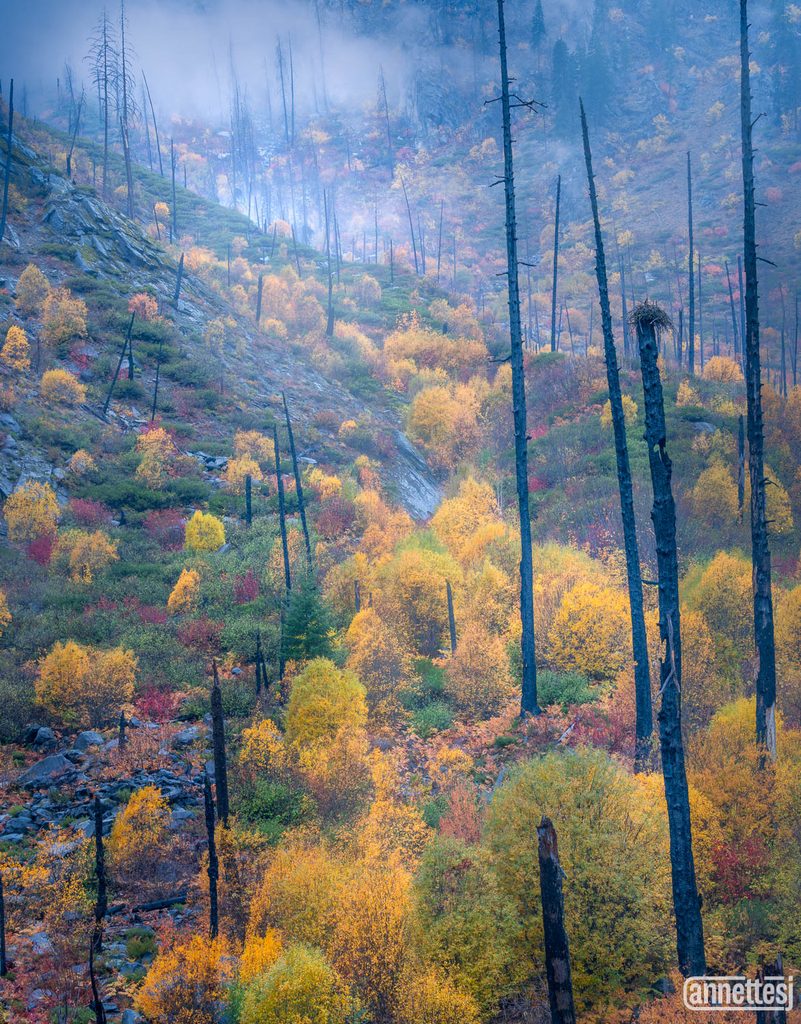
My next stop was at a picnic area along Highway 2, where I came across a hillside that looked quite different from the colorful forests I’d been photographing earlier. At some point in the past, there had been a mudslide in this area, and possibly a fire as well, that had taken out many of the trees. What remained was a hillside covered in golden shrubs and the bare snags of what had once been some very large trees.
Although it wasn’t the kind of scene we typically associate with beautiful fall foliage, I thought it had a lot of photographic potential. The dead trees stood out against the surrounding golden vegetation, and the fog and mist rising behind the hillside gave the whole scene a wonderfully moody atmosphere. The bare trunks almost looked like ghosts of the forest that had once covered the hillside.
When I encounter a scene like this, one of the biggest challenges is figuring out where to begin. There are so many different elements competing for attention, and it’s easy to get overwhelmed trying to decide what to include in the photograph. Sometimes the best thing to do is simply step back, take some time to look at the entire scene, and ask yourself what the photograph is really about.
For me, the answer was those bare tree snags climbing the hillside. Their shapes and arrangement were particularly interesting because they almost appeared to be marching in a line toward the clouds above. Combined with the misty atmosphere, they created a compelling story that was very different from simply photographing the bright fall colors.
Once I recognized that relationship, it became much easier to think about the composition. Rather than trying to capture every interesting element on the hillside, I could concentrate on arranging the snags within the frame so their repeating forms and upward progression became the primary focus. The golden vegetation provided a colorful backdrop and helped the dark trunks stand out, while the clouds reinforced the moody character of the scene.
What I particularly like about the resulting photograph is the way the trees seem to follow one another up the hillside, almost as though they’re marching toward the misty sky. That arrangement gives the viewer’s eye a natural path to follow through the image. The clouds in the background also contribute quite a bit to the photograph. They add atmosphere, but they also create separation between the hillside and the distant landscape, helping establish a stronger sense of depth.
This experience reinforced something I think is especially important when photographing complicated landscapes: before deciding how to frame a scene, try to identify what the story is really about. Once you recognize the most compelling relationship between the elements, it becomes easier to decide what belongs in the photograph and what doesn’t.
Sometimes that story is found in a repeating pattern, like the vertical lines of the aspens. Other times, it’s the relationship between contrasting colors or different layers of the landscape. In this case, it was the unusual arrangement of the bare trees combined with the moody atmosphere surrounding them.
When I’m struggling to find a composition, I also pay attention to where the light is most interesting or where clouds and atmospheric conditions are adding something special to the scene. Those elements can provide a starting point for identifying the strongest part of the landscape. On this hillside, the mist was an important part of what made the scene interesting, and it helped transform an otherwise rather stark collection of dead trees into a photograph with a distinct mood and story.
A Different Approach to Fall Photography on a Sunnier Day
My second day photographing along Highway 2 brought much sunnier conditions, which created some very different opportunities from the rainy, overcast weather I’d experienced earlier. During the first day, the soft light and low clouds had been particularly well suited to intimate forest scenes and layered telephoto compositions. With more sunshine, I had the opportunity to consider compositions that included a broader landscape and, potentially, some beautiful light and color in the sky.
As the day progressed and sunset approached, I began thinking about where I wanted to make my final photographs. I had a couple of different locations in mind, but rather than choosing a spot based only on the scenery, I paid attention to the clouds and where I thought the best sunset color might appear.
This was an important part of planning the composition. If I wanted the sky to be a meaningful element in the photograph, I needed to position myself somewhere that would give me a good view of the expected color while also providing an interesting foreground and surrounding landscape.
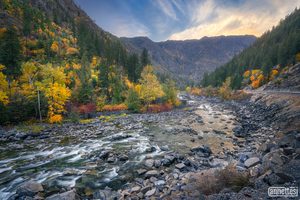
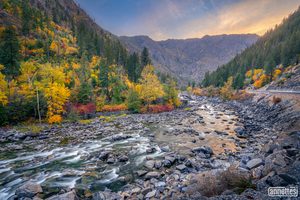
I eventually settled on a location where I thought all those elements might come together. I had flowing water in the foreground, beautiful fall foliage farther into the scene, and a mountain peak rising in the background. The river created a natural path for the viewer’s eye to follow through the photograph, connecting the foreground to the colorful trees and distant mountain. If the clouds developed the way I hoped, the sunset would provide another beautiful element to complete the composition.
Unlike the dense forest scenes I’d photographed earlier, this was a situation where I felt the entire landscape had something worthwhile to contribute. Instead of isolating a small portion of the scene with a telephoto lens, I wanted to include the foreground water, the fall colors, the mountain, and the sky together.
For this photograph, I felt a wide-angle composition was the right choice.
Knowing When to Use a Wide-Angle Lens Instead of a Telephoto
This final location gave me an opportunity to demonstrate the opposite approach from many of my earlier photographs. Throughout the trip, I’d frequently used a telephoto lens to simplify busy landscapes, eliminate distractions, and isolate smaller areas with strong patterns or contrasting colors. But a telephoto lens isn’t necessarily the best choice for every scene, and sometimes including more of the landscape creates a much stronger photograph.
The difference at this location was that nearly everything in the scene was working together. In the foreground, the flowing water provided movement and visual interest. Beyond the river, the brightly colored fall foliage added warmth and contrast, while the mountain peak established a strong background element. The river also acted as a leading line, drawing the viewer’s eye from the foreground toward the distant landscape.
And then there was the sky. Unlike the bright white skies I’d worked so hard to exclude from my earlier forest compositions, this sky was developing beautiful sunset color. It was an important part of the scene, and leaving it out would have meant losing one of the most compelling elements of the photograph.
Of course, even in a scene where most of the elements work well together, there can still be distractions. I had a few distracting areas in the bottom-right corner of the composition, so I did my best to crop those out and darken them to keep them from drawing attention away from the rest of the image.
What made the wide-angle approach successful was that each part of the landscape contributed something to the photograph. The water, foliage, mountain, and sunset weren’t competing with one another. Instead, they worked together to create a cohesive image with a clear foreground, middle ground, and background.
This is why I don’t think there’s one particular focal length that’s always best for landscape photography. A telephoto lens can be incredibly useful when photographing dense forests, especially when you want to isolate patterns or eliminate an uninteresting sky. But when the entire scene is interesting and the different elements complement one another, a wide-angle lens allows you to bring everything together into a single composition.
The important thing is to think about what you’re trying to communicate with the photograph and then choose the lens and framing that best support that story.
At this final location along Highway 2, I ended up taking two different photographs from the same spot: one during golden hour and another at sunset. Although the overall composition was similar, the changing light created two different interpretations of the landscape.
This was a great opportunity to compare how the quality and color of the light can influence a photograph, even when the underlying composition stays largely the same. I had already chosen this location because of the relationship between the river, fall foliage, mountain, and sky. But as the light changed, so did the appearance of those elements and the overall character of the scene.
Rather than choosing a single favorite, I thought it would be interesting to share both versions and see which one viewers preferred. Sometimes two photographs of the same scene can be successful for different reasons, and comparing them is a useful way to think about how light contributes to the final image.
Which do you prefer, the golden-hour photograph or the sunset version? I’d love to hear your thoughts in the comments.
Bringing It All Together: Creating Stronger Fall Photography Compositions
One of the biggest challenges of photographing fall colors is simply deciding where to begin. There can be so much beauty in every direction that it’s tempting to point the camera at everything and hope for the best. But a colorful landscape doesn’t automatically make a strong photograph. We still need to think carefully about how the elements work together and what we’re trying to communicate.
Throughout my trip along Washington’s Highway 2, I encountered several very different scenes, each with its own compositional challenges. In the dense aspen forests, I used a telephoto lens to isolate repeating patterns, strong contrasts, and beautiful colors while eliminating distracting elements. When I photographed the nearly bare aspens against the evergreens and low clouds, I concentrated on the distinct layers that gave the image depth and atmosphere.
At another location, a road winding toward colorful autumn trees provided a natural leading line, helping guide the viewer’s eye into the scene. And when I encountered the bare tree snags climbing a misty hillside, I found that identifying the story I wanted to tell made it much easier to decide how to compose the photograph.
Finally, at sunset, I took a completely different approach. Rather than isolating a small portion of the landscape, I used a wide-angle composition to bring together the flowing river, fall foliage, mountain, and colorful sky. In that situation, including more of the landscape made the photograph stronger because all of those elements contributed to the story.
The common thread in each of these photographs was the importance of being intentional about the composition. Before choosing a lens or deciding where to position the camera, it helps to step back and ask what it is about the scene that you find most compelling. Is it the color? The repeating patterns? The relationship between foreground and background? The atmosphere created by the weather? Or is it the way several elements come together to tell a larger story?
Once you have a clear idea of what you want to emphasize, the technical decisions become much easier. You can choose a focal length that includes the right amount of the landscape, adjust your position to minimize distractions, and experiment with different orientations and framing until the composition supports the story you’re trying to tell.
If you’d like to see these compositional decisions in action, be sure to watch my accompanying YouTube video, where I take you along for the trip and share my thought process as I photograph each location. You can also see more of my fall photography in the Autumn Landscapes Gallery.
You can also explore more of my landscape photography and learn about my virtual one-on-one photography coaching at Annette Stiers Jones Photography.
Thanks for coming along on this fall photography adventure!