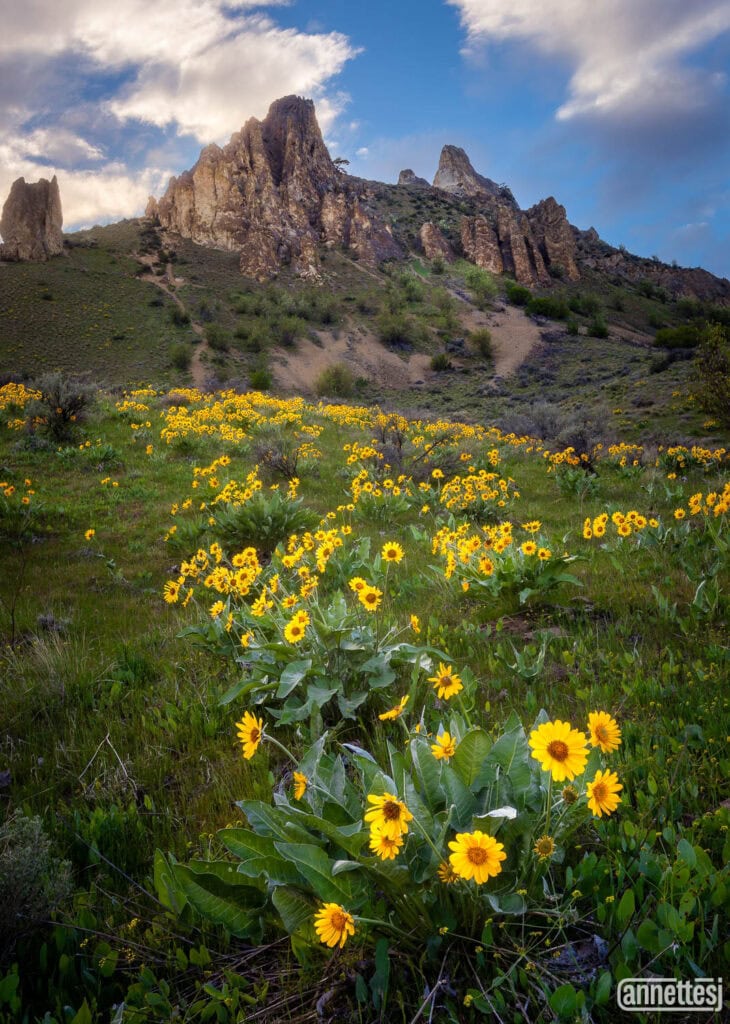
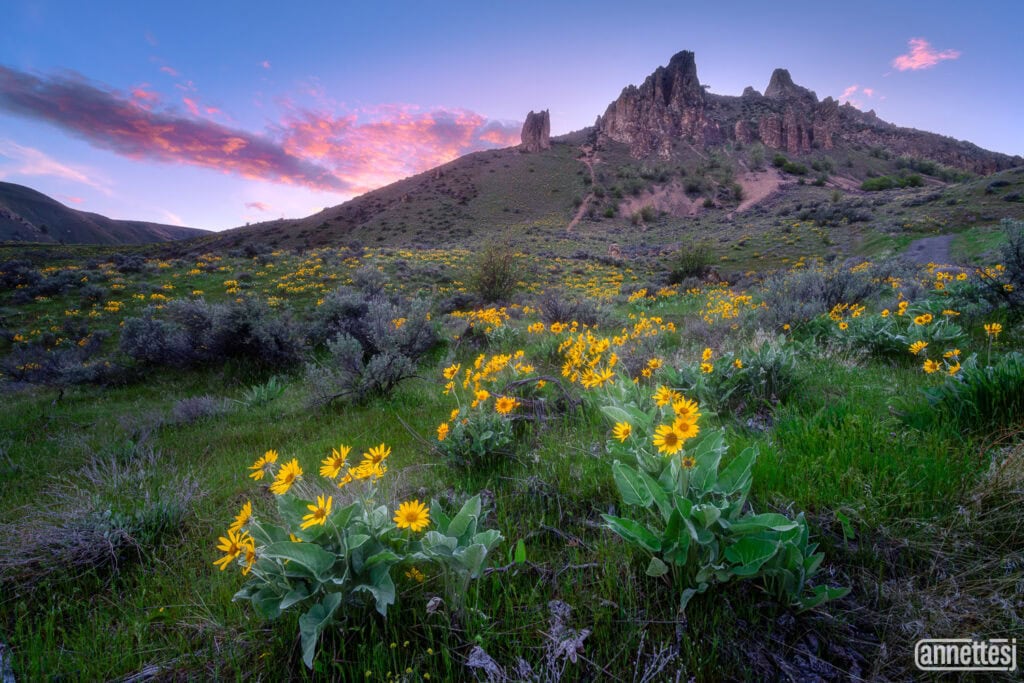
This is one of the most colorful moments of the year in Washington, when the hillsides near Wenatchee are covered in blooming balsamroot and, shortly after, vibrant lupine. In this vlog, I’m out in the field photographing these scenes and walking through exactly how I approach them using focus stacking and exposure blending to handle both depth of field and dynamic range. These conditions don’t last long, but when everything comes together—the flowers, the light, and the weather—it creates an opportunity for images that really capture the scale and beauty of spring in the Pacific Northwest.
Photographing Spring Wildflowers in Wenatchee
When I arrived, the balsamroot was in peak condition, filling the hillsides with bright yellow and creating strong natural leading lines through the landscape. What immediately stood out to me was how the flowers guided the eye toward a rocky peak in the distance, with the sun setting behind it and creating soft golden light across the clouds and landscape. Having very low wind made a huge difference here, because when you’re working with foreground elements just a few feet from the lens and trying to maintain sharpness throughout the frame, even small amounts of movement can complicate both focus stacking and blending later. These calmer conditions gave me much more flexibility to build a composition that extends from the foreground flowers all the way to the distant peak.
Building the Shot: Camera Settings and Setup
To capture this scene, I set my camera to manual mode and chose a narrow aperture of around f/16 to maximize depth of field. Even at that setting, I knew I would still need to rely on focus stacking to achieve full sharpness from front to back. Because the wind was minimal, I was able to use a relatively slow shutter speed, around 1/20 of a second, which allowed me to keep my ISO lower and maintain image quality while exposing properly for the foreground. This balance between aperture, shutter speed, and ISO is critical in scenes like this because you’re trying to preserve detail across a wide range of distances while also ensuring that nothing in the frame is unintentionally blurred due to motion.
Focus Stacking for Front-to-Back Sharpness
With my composition set, I switched to a small spot focus mode and began capturing a series of images at different focus distances. I started with the flowers closest to the lens, then moved incrementally into the midground, and finally focused on the distant peak. I took a separate image at each step while keeping all other settings consistent so the images would align cleanly during blending. This process ensures that every part of the scene is captured in sharp focus. While it may seem like overkill to take multiple frames, it’s always better to have more focus points than you need rather than discovering later that a critical part of the image falls outside your depth of field.
Exposure Blending for High Dynamic Range
In addition to depth of field, this scene also presented a significant dynamic range challenge. The foreground and mountain were in shadow, while the sky behind the peak was much brighter. After completing my focus stack for the foreground exposure, I adjusted my shutter speed to a much faster setting, around 1/250 of a second, to capture a separate exposure for the sky. I watched my histogram and highlight warnings to make sure I wasn’t clipping detail in the brightest parts of the image. This additional exposure allows me to retain full color and detail in the sky, which can then be blended with the foreground during post-processing to create a balanced final image that more closely reflects what the scene looked like in person.
Refining Composition: Horizontal vs. Vertical
After capturing the initial horizontal composition, I experimented with a vertical frame and found that it strengthened the image by emphasizing the natural flow of the balsamroot leading directly up into the peak. The vertical orientation created a more immersive sense of depth and direction. In the final edit, I only needed two focus points—one for the foreground and one for the background—along with the sky exposure. Even though I had captured more frames than I ultimately used, having extra options gave me flexibility later without risking gaps in focus or exposure coverage.
Adapting to Changing Conditions in the Field
As sunset progressed, the wind began to pick up. That introduced more movement in the flowers and made focus stacking more difficult. To adapt, I stepped slightly farther back from the foreground, increased my ISO to allow for faster shutter speeds, and prioritized sharpness over being extremely close to the flowers. Once motion becomes a factor, maintaining clean, sharp frames becomes more important than maximizing foreground size. These kinds of adjustments are often necessary in the field because conditions can change quickly, and your technique needs to respond to what the environment allows.
Final Image and Takeaways
I was really happy with how this composition came together, combining the bright color of the balsamroot with the soft, warm tones of the sunset sky. The final image ended up using just two exposures for focus stacking along with one exposure for the sky, which simplified the blending process while still achieving a clean, detailed result. Wildflower season in Washington is relatively short, but when the light, weather, and bloom timing align, it creates some of the most rewarding opportunities for landscape photography. Techniques like focus stacking and exposure blending are what allow you to fully capture the depth, detail, and dynamic range of these scenes rather than settling for a compromise in a single frame.
See the Washington wildflower photo prints here and here.
Want to Learn These Techniques?
If you want to take this further, I offer one-on-one landscape photography coaching where we can work through these techniques together, including how to approach scenes in the field, how to capture images for focus stacking and exposure blending, and how to process them in Lightroom and Photoshop to create natural, polished results. Learn more here: Landscape Photography Coaching.